
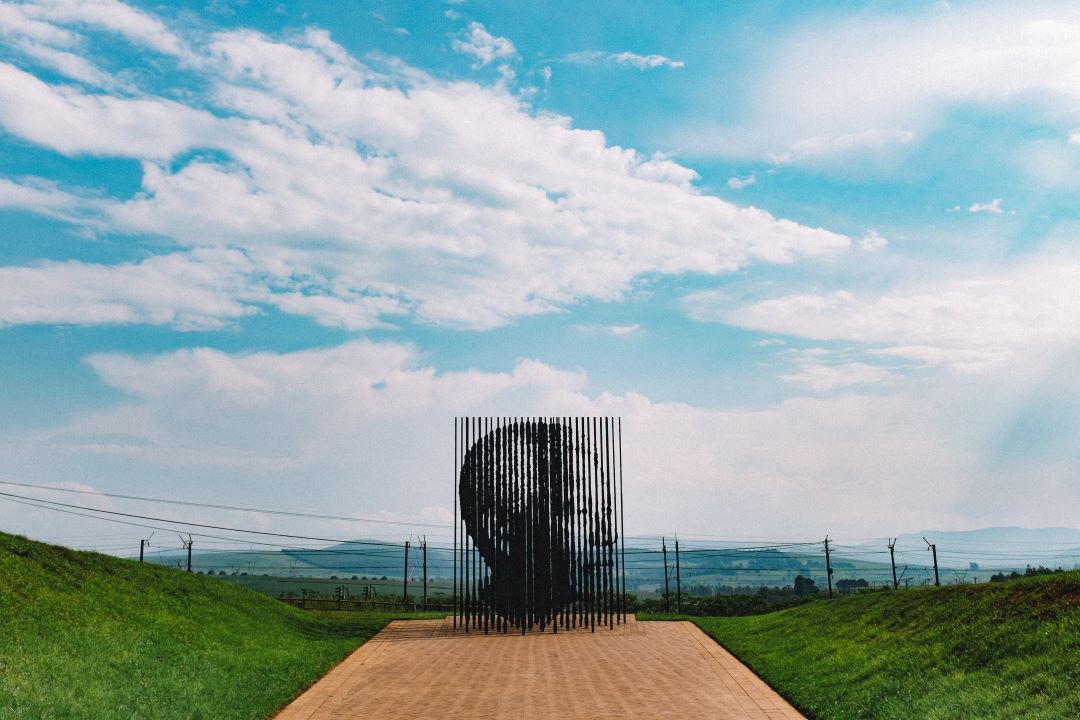
Nelson Mandela sculpture: Howick, South Africa
“During my lifetime I have dedicated myself to this struggle of the African people. I have fought against white domination, and I have fought against black domination. I have cherished the ideal of a democratic and free society in which all persons live together in harmony and with equal opportunities. It is an ideal which I hope to live for and to achieve. But if needs be, it is an ideal for which I am prepared to die.”
–Nelson Mandela; April 20, 1964
Nelson Mandela was sentenced to life in prison after a trial held in 1964. He served twenty-seven (27) years in prison. He was “convicted” and sent to prison by the government of South Africa after advocating for the use of violent tactics to combat the oppressive and racist system of Apartheid. His conviction and sentence were racially and politically motivated and due to his unwavering and vocal opposition to the Apartheid regime.
This injustice, against him personally and his people generally, made him very angry. Most everyone would agree that he had every right to be angry and resentful. Most everyone would agree that, upon being released from prison in 1990, he had every right to seek retribution and vengeance upon those who had put him there.
But he didn’t. He had let go of his anger. He sought reconciliation instead of revenge. He received the Nobel Peace Prize in 1993. He became South Africa’s first democratically elected President in 1994. His leadership led to an unprecedentedly peaceful transition from the tyrannical rule of Apartheid to a lasting and inclusive democracy. In the process, he became a global symbol as a peacemaker and a widely trusted and respected leader.
In his inaugural address, Mandela stated the following:
“We have triumphed in the effort to implant hope in the breasts of the millions of our people. We enter into a covenant that we shall build the society in which all South Africans, both black and white, will be able to walk tall, without any fear in their hearts, assured of their inalienable right to human dignity—a rainbow nation at peace with itself and the world. .
The time for the healing of the wounds has come.
The moment to bridge the chasms that divide us has come.
The time to build is upon us. . . .”
Mandela was certainly a man who had long believed that South Africans could live in harmony with one another. But what about his anger and resentment for being unjustly imprisoned? What happened during those 27 years? What led to his personal philosophy to seek unity and healing instead of mistrust and violence?
Mandela was forced to live almost three decades locked away from his family and freedom, only to walk away from his imprisonment with peace in his heart and a vision to transform his country into a “rainbow nation.”
I’m sure that his inspiration and influences were many and varied, but we also know the following:
- At some point a fellow prisoner smuggled a copy of Marcus Aurelius’ personal journal “Meditations” into the prison and it was shared with and read by Mandela;
- His favorite line of poetry was “I am the master of my fate, I am the captain of my soul” from the poem “Invictus” written by William Ernest Henley. Mandela often recited the self-empowering poem to other prisoners.
“Meditations” is a compilation of entries from the personal journal of Marcus Aurelius, the Emperor of Rome from 161 AD to 180 AD. It consists of notes to himself and his ideas and musings regarding Stoic philosophy. It is very doubtful that Aurelius ever intended his personal writings to be published. Yet, two thousand years after it was written, a copy of his journal was read by a man destined to inspire and lead millions to a new and seemingly impossible era of harmony.
William Ernest Henley, an Englishman and Victorian era Stoic, wrote “Invictus” (meaning “unconquered”) in 1875. He was twenty-five years old and wrote the poem while recovering from a series of surgical procedures that saved his right leg from being amputated. His left leg had been amputated when he was sixteen. Former President Barack Obama quoted Mandela’s favorite line of poetry from “Invictus” while speaking at Mandela’s memorial service in 2013.
It is not known if Mandela considered himself a Stoic and I’m not even sure what point, if any, I’m trying to make in this rambling essay about Nelson Mandela. It’s probably best that I simply conclude with additional quotations from Mandela mixed with similar thoughts by Aurelius in “Meditations”, and the entirety of the poem that Nelson Mandela loved so much.
Quotes and a Poem:
“…The cell is an ideal place to learn to know yourself.” –Nelson Mandela in a letter written to Winnie Mandela from Kroonstad Prison, February, 1975
“Very little is needed to make a happy life; it is all within yourself, in your way of thinking.” -Marcus Aurelius
“Many people direct blame at others and the world, and never at themselves. If you cannot notice your flaws, you cannot improve and communicate with the flawed.”-Nelson Mandela
“Whenever you are about to find fault with someone, ask yourself the following question, what fault of mine most nearly resembles the one I am about to criticize.” -Marcus Aurelius
“Resentment is like drinking poison and then hoping it will kill your enemies.” -Nelson Mandela
“The best revenge is to be unlike him who performed the injury.” -Marcus Aurelius
“Invictus” By William Ernest Henley
Out of the night that covers me,
Black as the pit from pole to pole,
I thank whatever gods may be
For my unconquerable soul.
In the fell clutch of circumstance
I have not winced nor cried aloud.
Under the bludgeonings of chance
My head is bloody, but unbowed.
Beyond this place of wrath and tears
Looms but the Horror of the shade,
And yet the menace of the years
Finds and shall find me unafraid.
It matters not how strait the gate,
How charged with punishments the scroll,
I am the master of my fate,
I am the captain of my soul.


Michael Shawn Harmon
Latest posts by Michael Shawn Harmon (see all)
- A Game of Numbers: Sperm Count & Semen Analysis - November 21, 2019
- Mind the Gap: Varicocele, Surgery & Gonads (Again) - November 21, 2019
- Lost in Translation: Testosterone Replacement Therapy, the HPG Axis, Infertility & Marital Stress - November 21, 2019